
Calabasas Probate Administration Lawyer

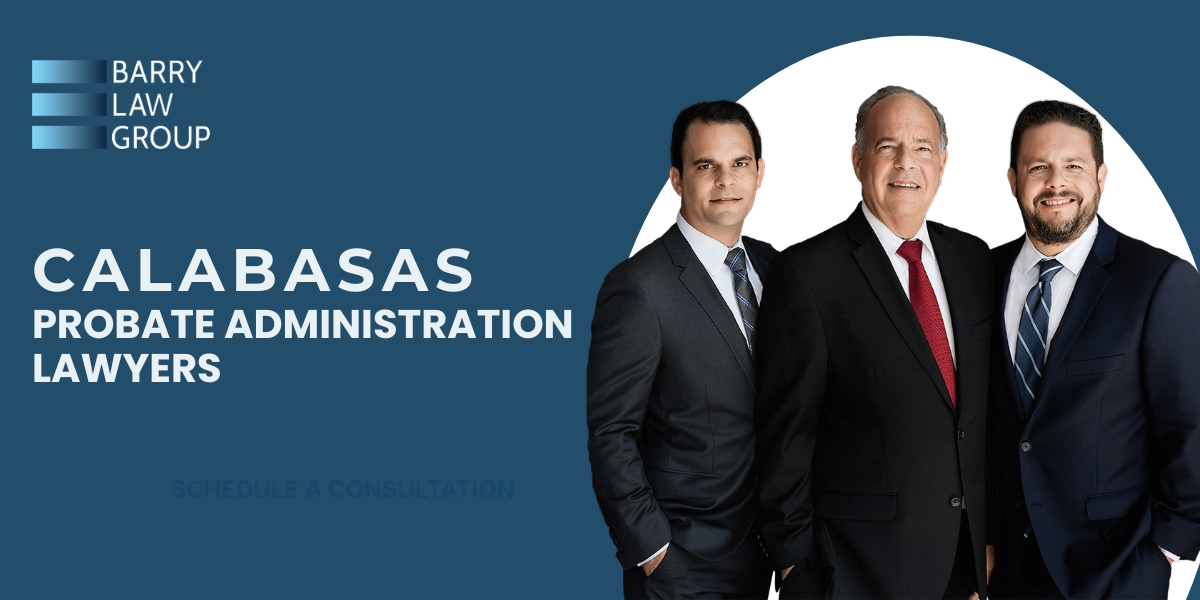
Probate Administration Attorney in Calabasas, CA
One of the most challenging experiences someone can experience is the loss of a loved one. Unfortunately, the legal aspect of their passing can make the experience exponentially worse, particularly if issues arise. If you have recently lost a loved one and are unclear about your next steps or need help protecting your rights, speaking with an experienced Calabasas probate administration lawyer should be a priority.
Skilled Probate Administration Support in Calabasas
When working with our team, you can expect impeccable professionalism and a tenacious pursuit of a favorable outcome for your situation. Whether you need guidance on probate administration, assistance with trust litigation, or support through estate litigation, our attorneys are here to help every step of the way.
Navigating California’s probate laws can be difficult, even more so when you are also processing your grief. Barry Law Group understands how challenging this experience can be and can approach your case with the compassion and dedication you deserve.
Estate Administration and Probate
When someone dies in California, their estate must pass through estate administration before their property can be distributed to the beneficiaries. There are two main ways this happens, and they are explained below:
- Testate Succession: When a person dies with a valid will in place, they are said to have died testate. This means their property will be distributed in accordance with their wishes specified in their will. Within the will, the decedent will have named an executor who is responsible for administering the estate.
- Intestate Succession: When a person dies without a valid will in place, they are said to have died intestate. During intestate succession, the property within an estate will be distributed according to California Probate Code 6400-6455.
A 2025 study found that only three in 10 adults in the United States have created a will or living trust. When there is no will present, intestate laws apply, and an estate administrator is appointed by the court to assume the role of an executor.
If you have been appointed as an administrator by the court or even an executor by a will, connecting with an experienced probate administration attorney can be a valuable choice. Their insight into and knowledge of the law can help make the process much less difficult.
A Step-by-Step Guide to California Probate
Probate is not often a quick and simple process. The total time it takes to complete probate is situation-dependent, but it typically ranges from several months to more than a year. During this time period, the steps that must be completed are outlined below:
- File the petition: The petition must be filed with the original will to the court within the county where the decedent resided immediately preceding their death.
- Publish the Notice of Hearing: Published in a local newspaper one day each week for three weeks, this notice serves to inform creditors and unknown heirs of the probate proceeding.
- Post a bond: In many instances, Probate Courts require executors or administrators to post a California probate bond to protect the estate and its beneficiaries.
- Prove the will: It must be shown that the decedent’s will was prepared and executed in accordance with California’s laws.
- Collect and distribute estate assets: The executor or administrator is responsible for collecting the eligible probate assets and changing ownership to the beneficiaries. Some assets may be sold during the probate process.
- Pay estate creditors: Known creditors must be contacted, and then they will submit a claim against the estate. Any valid claims must be paid before assets can be distributed to the beneficiaries.
- Pay estate taxes: Tax returns may need to be filed for the decedent, the estate, the executor, or the administrator.
- Close the estate: A complete and final accounting of the actions taken during probate is presented to the court.
Types of Disputes that Can Come Up During the Probate Administration Process
Probate administration can become contentious when family members, creditors, beneficiaries, or the executor disagree about how an estate is being handled. These disputes can arise at nearly every stage of the probate process and can significantly disrupt or delay asset distribution. Some of the most common reasons for disputes are listed below:
- An invalid will. If a party believes that a will is invalid, it can put into question whether the instructions on asset management can be adhered to. A will may be invalid if it can be proven that the deceased lacked the mental capacity to create a will, was subject to undue influence, was coerced, or signed the will as a result of fraud or coercion.
- Mismanagement of estate assets by the executor. An executor or administrator has a fiduciary duty to manage all estate assets. This involves avoiding acting out of personal gain and protecting and maintaining all assets properly. A dispute can arise if another person suspects an executor of breaching this duty, such as by using assets for personal expenses, unauthorized sale of estate assets, or poorly handling finances.
- Improper estate distribution by the executor. An executor must either follow the instructions provided in a will or other estate planning document, or they must adhere to the court’s intestate succession laws. Disputes can happen if an executor ignores estate planning documents or intestate laws by changing inheritances, denying inheritance to certain heirs, or distributing additional assets to themselves.
- Creditor claims. Claims against the estate are common for outstanding debts, loans, or medical bills owed by the deceased. However, there are sometimes disputes over whether a claim is valid or involves an accurately calculated debt. Resolving these claims is essential, as assets cannot be transferred to heirs until debts are settled.
- Disagreement on asset valuation. Conflicts can occur when heirs disagree about the fair market value of estate assets. This often involves real estate, business assets, investment accounts, and other assets that can be more difficult to accurately value. Settling these disputes requires a complex analysis of financial records and valuation reports.
How Disputes Are Resolved in Probate
Many probate disputes can be resolved without court involvement, such as through negotiations or mediation with the help of a skilled Calabasas probate attorney. However, when a probate administration case cannot be settled, it can move to court.
These cases are handled by one of two Superior Courts of California. Central District Calabasas probate administration cases are heard at the Stanley Mosk Courthouse on North Hill Street in Los Angeles. Northwest District probate administration cases are heard at the Van Nuys Courthouse on Sylmar Avenue in Van Nuys.
This process begins by filing a petition with the court, asking the court to take a specific action, such as invalidating a will or removing an executor. Whether you need help filing a petition or you have recently learned that someone filed an inaccurate claim, you should hire a probate administration lawyer early on in the process.
The next step towards resolution involves presenting evidence to support your claim, such as estate planning documents, financial documents, records of communication, or medical records. The judge uses this evidence to determine whether to take the action proposed in the filing or not.
A Closer Look at the Probate Process in Calabasas
The probate courts focus on settling estates and other probate-related matters. For cases arising out of estates in Calabasas Park, Hidden Hills, and other nearby neighborhoods in Calabasas, probate cases are generally heard by the Los Angeles County Superior Court’s Probate Division at the Stanley Mosk Courthouse.
This building, which was built in 1958, serves as the administrative center of the nation’s largest trial court system and hears thousands of probate, trust, conservatorship, and guardianship matters every year. The superior court system assigns probate cases to probate-specific departments staffed by judges who focus on estate administration and trust litigation.
At these buildings, probate attorneys called probate examiners review petitions and issue Probate Notes identifying deficiencies or requests for additional information needed before a judge can make a ruling.
The Stanley Mosk Courthouse is open from 7:30 am to 4:30 pm, while the Clerk’s Office remains open from 8:30 am to 4:30 pm Monday through Friday, except on court holidays. Parking is available via various parking lots throughout the courthouse. There are metered spaces available along Grand Avenue and Hill Street, although access is limited.
The representative of an estate is expected to file a petition with the appropriate probate court within 30 days of knowledge of the death of the decedent. Given the estimated 9,694,934 people who live in Los Angeles County, the Stanley Mosk Courthouse is one of the busiest probate courts in the state. As a result, families should expect the process to take time. Depending on the court’s calendar, obtaining an initial hearing could take several weeks or longer.
Letters of Administration or Testamentary Letters are often issued shortly after the hearing. Missing paperwork, Probate Notes issued by the court, creditor claims, or disputes among beneficiaries can delay the process. California law requires the appointment of a Probate Referee in most formal probate administrations to appraise certain non-cash estate assets.
Probate referees are independent officials appointed by the State Controller who determine the fair market value of assets like homes, commercial real estate, investment properties, business interests, and certain personal property. Their appraisals are used by the court to establish the value of the estate for probate administration and distribution purposes.
Another step that surprises many families is the requirement to publish a Notice of Petition to Administer Estate in a court-approved newspaper before the initial hearing. Depending on where the decedent lived, this notice may appear in an adjudicated publication serving the area, such as the Los Angeles Daily News, The Acorn, or another newspaper approved by the Los Angeles Superior Court.
Understanding an Executor’s Fiduciary Duties and Potential Liability
Serving as the executor of an estate is a significant legal responsibility. Under California law, an executor or court-appointed administrator acts as a fiduciary. This means that they must act in the interests of the estate and its beneficiaries. Honoring legitimate debts is another responsibility. Personal representatives cannot use estate property for their own benefit, favor one beneficiary over another without legal authority, or make decisions that conflict with their obligations.
Executors are expected to exercise reasonable care in these matters, maintain accurate financial records, preserve estate assets, and keep beneficiaries informed when required. If they do not comply with all court orders or uphold these responsibilities, they could be held liable. One of the executor’s first responsibilities is preparing the estate’s inventory.
California generally requires the personal representative to file this document within four months after Letters Testamentary or Letters of Administration are issued. The inventory should identify the estate’s assets, while the court-appointed Probate Referee is tasked with calculating the value of non-cash assets. Filing an accurate inventory on time could help move the probate case forward in a timely manner.
Executors should also understand that they may face personal liability for certain mistakes. For example, distributing inheritances before paying valid debts, taxes, or administrative expenses can expose the executor to claims from creditors. Federal tax obligations, California Franchise Tax Board liabilities, Medi-Cal estate recovery claims, and other lawful debts generally must be addressed before estate assets are distributed.
An executor who improperly pays beneficiaries first may be held financially liable. Given those risks, many executors rely on the support of probate attorneys when navigating these steps. Additional liabilities can result from failing to safeguard estate property or missing filing deadlines. Selling assets for less than fair market value without proper authority can also lead to complications. An attorney can guide the process while shielding the representative from liability.
Hire a Probate Administration Lawyer from Barry Law Group
For over 38 years, Barry Law Group has been committed to helping members of the community nestled in the Santa Monica Mountains through legal issues with integrity and passion. As our team has grown, so have our capabilities. All the while, though, we have remained dedicated to delivering exceptional legal services. We believe each client is owed legal representation marked with the elements listed below:
- Transparency: We communicate honestly and openly with our clients to maintain the highest standards of legal professionalism and ethics.
- Top legal strategies: Our legal strategies are tailored to your specific legal needs.
- Unmatched dedication: Our team is dedicated to representing our clients with commitment, passion, and integrity.
- Impeccable performance: We have a long history of high client satisfaction, which lends itself to long-term relationships with clients and high referral rates from previous clients.
When you hire a probate administration lawyer, you gain the support of an attorney who understands California’s probate administration laws and how they could influence the outcome of your probate administration case.
A Calabasas probate administration attorney can begin by carefully listening to your goals and concerns about the current probate case. Once they understand your aims, they can take decisive steps to protect your interests in court.
Litigation can be complex, and missteps can be costly. When you work with the right attorney, you will not have to worry about being left out of the court process. Any concerns you have, such as potential conflicts of interest, unfounded claims to an estate, or failings of the estate administrator, can be directly addressed.
Whether the estate is in Hidden Hills, Vista Point, Calabasas Park, or elsewhere in Calabasas, California legal support can make sure that the probate process results in a fair outcome based on a clear understanding of the decedent’s wishes.
FAQs
Do I need a Lawyer for Probate in Calabasas, CA?
In FY 2024-2025, the state saw 66,908 probate filings, making probate cases far from uncommon. In Calabasas, CA, the need for a lawyer while going through probate is dependent on the circumstances, but most people will benefit from the support of a probate lawyer. In simple estates where the decedent thoroughly planned for their death, an attorney may not be required. However, probate is a legal process that can be marked by many difficulties, so an attorney is often recommended.
What Is the Difference Between a Probate Lawyer and an Estate Lawyer?
The main difference between a probate lawyer and an estate lawyer is when you utilize their services. A probate lawyer helps their clients through probate by helping them settle a decedent’s estate. An estate lawyer helps their clients plan for their death or incapacitation by creating a legally binding estate plan.
How Much Does a Probate Administration Lawyer Cost in California?
The cost of a probate administration lawyer depends on the total value of the decedent’s estate. Sections 10810-10814 of the California Probate Code determine the fees charged by attorneys. For ordinary services, the fee starts at 4% for the first $100,000, then changes to 3% for the next $100,000, 2% for the next $800,000, 1% for the next $9 million, and 0.5% for the next $15 million. The court determines a reasonable value for estates valued over $25 million.
Is Probate a Requirement in California?
Probate is not always a requirement in California. If the decedent created a revocable living will or other estate plan that accounts for all their property, their estate may not need to go through probate. Additionally, small estates valued at less than $208,850 may be able to avoid probate. A probate lawyer can help you determine which parts of probate, if any, your loved one’s estate must go through.
Calabasas Probate Administration Lawyer
Whether you are representing an estate in probate or have a stake in the outcome of a probate case, having legal support matters. Attorney Steven Barry opened his practice in 1988 to provide Californians with top-rated legal services. Nearly 40 years later, his two sons joined him, forming Barry Law Group. Today, our boutique litigation firm focuses on providing high-quality representation to clients and unwavering support during challenging times.
When you work with our firm, you are connected to one of our lead attorneys, who takes a hands-on approach to managing your claim from day one. Whether you are initiating probate, defending against allegations of misconduct, resolving a trust dispute, or protecting your inheritance rights, experienced legal guidance can help you make informed decisions and protect your interests throughout the probate process.
Barry Law Group is committed to helping our community through probate while you grieve your loved one. If you are in this position, please contact our team to schedule a consultation and learn how we can assist you.
Success of Your
Legal Matter.
Barry Law Group is comprised of attorneys and longtime staff members who are committed to the success of your legal matter. The firm understands that for most litigation is uncharted worrisome and often terrifying.

Business Address
16633 Ventura Blvd. Suite 1000
Encino, California 91436
9:00am – 5:00pm
Monday through Friday
Contact Us
-
Call
(818) 789-9444(818) 789-3233 -
Mail
[email protected]
© Copyright Barry Law Group 2026. All rights reserved.
Disclaimer | Site Map | Privacy Policy
Digital Marketing By 
*Images are obtained under license from Canva and other third-party stock image providers, with attribution included where required.